
Do you want to improve your fitness, burn calories, and feel more active without stepping outside your home? Cardio workouts at home are one of the easiest ways for beginners to get started without pressure, equipment, or complicated routines.
You don’t need a gym membership or long workout hours to get your heart pumping and your body moving. Simple movements done consistently can improve stamina, support fat loss, and help you feel more energetic throughout the day.
Home cardio workouts fit easily into busy schedules and allow you to move at your own pace without feeling rushed or judged. Whether your goal is better health, weight control, or building an exercise habit, starting at home removes many barriers and makes fitness feel more manageable from day one.
Why Do Cardio Exercises at Home?
Doing cardio exercises at home is one of the most practical ways for beginners to stay active without feeling overwhelmed. One of the biggest benefits is convenience. You don’t have to spend time commuting to a gym, waiting for machines, or adjusting your day around workout schedules.
When exercise is easily accessible, it becomes easier to stay consistent, which plays a major role in long-term results. Even short sessions done regularly can support heart health, improve breathing, and increase daily movement levels.
Home cardio workouts also offer flexibility. You can choose when to work out, how long to move, and how intense the session should be. This flexibility allows beginners to listen to their bodies and progress at a comfortable pace.
If energy levels are low, lighter movements still count. On days when motivation is higher, intensity can be increased without pressure. Another advantage is comfort. Working out at home removes self-consciousness that often stops beginners from exercising.
There is no comparison, no audience, and no fear of doing movements incorrectly in front of others. This relaxed setting allows people to focus on form, breathing, and gradual improvement. Over time, confidence builds naturally as movements start to feel easier.
Cardio exercises at home also help build healthy habits. When workouts fit into everyday life, they are more likely to stick. Simple activities like marching, stepping, or light jumps help raise the heart rate and improve endurance.
With consistency, these movements support calorie use, better sleep, improved mood, and stronger daily energy levels. Home cardio proves that fitness does not require complicated routines—just regular movement and commitment.
Tips For Cardio Exercises at Home
- Start slow and build gradually. Beginners should focus on learning movements properly before increasing speed or duration. Starting slow reduces the risk of soreness and makes it easier to stay consistent without feeling exhausted.
- Warm up before every session. A short warm-up prepares the muscles and joints for movement. Marching in place, arm swings, or gentle steps help the body transition into exercise safely.
- Choose low-impact options when needed. Stepping instead of jumping or slowing down movements helps protect joints while still keeping the heart rate elevated.
- Focus on breathing. Steady breathing helps control effort and prevents early fatigue. If breathing becomes too heavy to manage, it’s a sign to slow down.
- Wear supportive footwear. Proper shoes provide stability and reduce strain on the feet, knees, and ankles during repeated movements.
- Keep workouts short but regular. Even 15 to 20 minutes of cardio done several times a week supports progress better than long sessions done occasionally.
- Listen to your body. Rest when needed and adjust movements if discomfort appears. Progress should feel challenging but manageable.
Stay hydrated. Drinking water before and after workouts helps maintain energy and supports recovery.
1. Jumping Jacks
Jumping jacks are a simple full-body movement that raises the heart rate quickly while engaging the arms, legs, and core. This exercise helps beginners improve coordination and stamina without needing equipment.
The movement encourages steady breathing and promotes calorie use when performed continuously. Jumping jacks can be adjusted easily by stepping side to side instead of jumping, making them suitable for different fitness levels.
Because they involve rhythmic motion, they are often used at the beginning of cardio routines to get the body moving and warmed up.
How to Do It?
- Stand upright with feet together and arms resting by your sides, keeping your posture tall and relaxed before starting the movement.
- Jump both feet outward while lifting your arms overhead in a smooth motion, allowing your body to stay balanced and controlled.
- Bring your feet back together while lowering your arms to the starting position, maintaining steady breathing throughout the movement.
- Continue moving at a pace that feels manageable, focusing on soft landings to reduce stress on the joints.
- If jumping feels difficult, step one foot out at a time while raising your arms to maintain the same pattern without impact.
How It Helps:
Jumping jacks improve cardiovascular endurance by keeping the heart rate elevated for extended periods. They activate multiple muscle groups, which supports calorie use and overall body coordination. This exercise also helps improve rhythm and movement control, making it a useful choice for beginners working on building exercise confidence at home.
2. High Knees
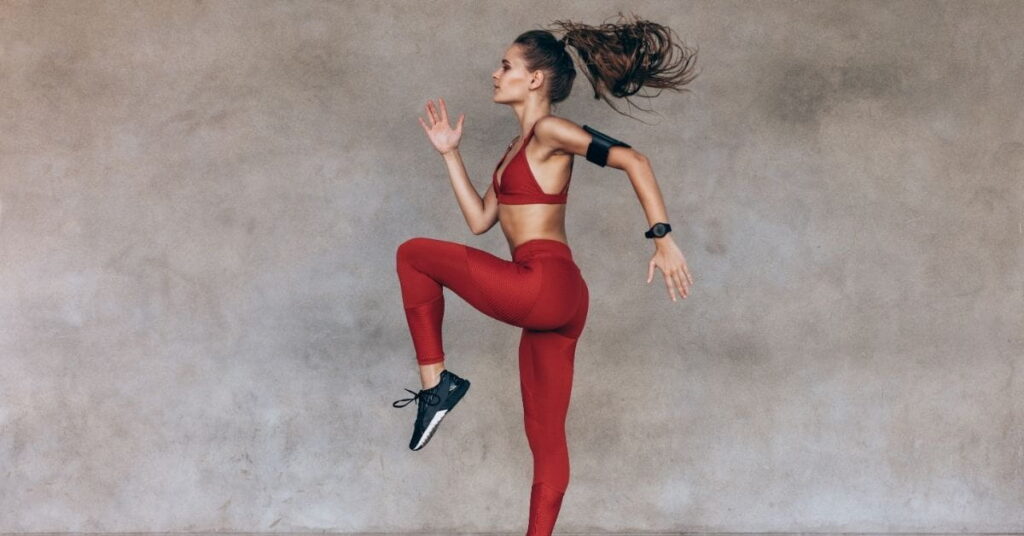
High knees are an effective cardio movement that focuses on the lower body while engaging the core and arms. This exercise increases heart rate quickly and supports improved balance and coordination.
High knees can be performed at different speeds, making them suitable for beginners who want a flexible cardio option. The movement encourages upright posture and steady breathing while building endurance. It can be modified easily by slowing the pace or lifting the knees to a comfortable height.
How to Do It?
- Stand with your feet hip-width apart and arms bent at your sides, preparing your body for controlled movement.
- Lift one knee toward your chest while keeping your upper body upright and your core engaged.
- Lower the leg and switch sides, moving in a marching or running-in-place pattern based on comfort.
- Swing your arms naturally to support balance and maintain rhythm throughout the exercise.
- Adjust speed and height to keep the movement controlled while avoiding strain.
How It Helps:
High knees strengthen the legs and improve cardiovascular endurance. The movement increases coordination while supporting better balance and core engagement. Practicing this exercise regularly helps build stamina and supports calorie use without requiring large spaces or equipment.
3. Marching in Place
Marching in place is a beginner-friendly cardio exercise that keeps the body active while minimizing impact on the joints. This movement helps raise the heart rate gradually and supports better coordination and balance.
Marching is ideal for beginners who want a controlled pace while building consistency. It can be done anywhere and adjusted easily by increasing arm movement or lifting the knees slightly higher over time.
How to Do It?
- Stand tall with feet hip-width apart and arms relaxed at your sides before beginning the movement.
- Lift one knee toward your chest while keeping your posture upright and your gaze forward.
- Lower the leg and repeat on the opposite side, maintaining a steady and controlled pace.
- Swing your arms gently to match the leg movement and support balance.
- Continue marching for the desired time while focusing on smooth, steady breathing.
How It Helps:
Marching in place supports cardiovascular health while remaining easy on the joints. It helps beginners stay active, improve coordination, and build a regular exercise habit. This movement also promotes steady energy use and helps prepare the body for more challenging cardio exercises later.
4. Mountain Climbers
Mountain climbers are a dynamic cardio exercise that combines upper-body support with fast lower-body movement. This exercise challenges coordination while keeping the heart rate elevated throughout the motion.
It engages the arms, shoulders, core, and legs at the same time, making it effective for full-body conditioning. Beginners can perform mountain climbers at a slower pace to maintain control and reduce fatigue.
How to Do It?
- Begin in a plank position with your hands placed firmly under your shoulders and your body forming a straight line from head to heels.
- Tighten your core muscles to keep your hips steady and avoid sagging or lifting too high.
- Bring one knee toward your chest while keeping the opposite leg extended and your upper body stable.
- Switch legs smoothly, moving in a controlled, running-like motion while maintaining balance.
- Continue alternating knees at a pace that allows steady breathing and consistent movement.
- Slow the motion or step the feet forward one at a time if speed becomes difficult to manage.
How It Helps:
Mountain climbers improve cardiovascular endurance while strengthening the core and upper body. The continuous leg movement increases heart rate, supporting calorie use and stamina development.
5. Fast Feet Shuffle
Fast feet shuffle is a low-position cardio exercise that focuses on quick foot movement and lower body engagement. It keeps the heart rate elevated while improving coordination and reaction speed.
How to Do It?
- Stand with your feet hip-width apart and slightly bend your knees to lower your center of gravity.
- Keep your chest lifted and your core engaged to maintain balance throughout the movement.
- Begin moving your feet quickly in place, alternating steps while staying light on your toes.
- Allow your arms to move naturally to help maintain rhythm and coordination.
- Continue the movement for a set time, then slow down gradually instead of stopping suddenly.
- Reduce speed or straighten slightly if fatigue affects form.
How It Helps:
Fast feet shuffle boosts cardiovascular fitness, strengthens the lower body, and improves agility and coordination.
6. Step Touch Side to Side
Step touch side to side is a gentle cardio movement that supports a steady heart rate increase while remaining low-impact. This exercise is ideal for beginners who prefer controlled motion without jumping.
How to Do It?
- Stand upright with your feet together and arms relaxed, preparing for smooth side movement.
- Step one foot out to the side while shifting your weight smoothly onto that leg.
- Bring the opposite foot in to meet the stepping foot, keeping the movement controlled.
- Repeat the motion on the other side, maintaining an even pace and steady breathing.
- Add gentle arm swings if comfortable to increase engagement and rhythm.
- Continue alternating sides for the desired duration without rushing the steps.
How It Helps:
Step touch supports cardiovascular health, balance, and coordination while remaining easy on the joints.
7. Skater Steps
Skater steps mimic a side-to-side skating motion, providing a dynamic low-impact cardio option for beginners. This exercise engages the legs, glutes, and core while improving balance and agility.
It is easy to perform at home and requires minimal space. Skater steps gradually increase heart rate while enhancing coordination, making them effective for building cardiovascular endurance and lower body strength.
How to Do It?
- Start in a slight squat position with feet hip-width apart and knees slightly bent, arms relaxed by your sides.
- Shift your weight onto your left leg and step your right leg behind your left leg, landing gently while swinging your arms naturally.
- Push off your left leg to return to the starting position, maintaining control throughout the motion.
- Repeat the movement on the opposite side, alternating legs in a flowing, rhythmic pattern.
- Focus on steady breathing, smooth transitions, and keeping your knees slightly bent to avoid strain.
How It Helps:
Skater steps strengthen leg muscles, particularly glutes and quads, while improving coordination and balance. They provide a moderate cardiovascular challenge, supporting heart and lung function. This exercise helps beginners practice controlled dynamic movement and develop endurance for more complex cardio routines.
8. Standing Knee Lifts with Arm Reach
This exercise combines gentle cardio with upper-body movement, engaging the core, legs, and arms simultaneously. It is beginner-friendly and performed in place, making it convenient for home workouts. Standing knee lifts with arm reach help improve posture, coordination, and circulation while gradually increasing heart rate.
How to Do It?
- Stand upright with feet hip-width apart and arms at your sides, ensuring your posture is straight and core engaged.
- Lift your right knee toward your chest while extending your left arm upward, reaching toward the ceiling.
- Lower your leg and arm slowly, returning to the starting position with control.
- Repeat on the opposite side, alternating arms and legs in a smooth, continuous motion.
- Maintain steady breathing and a comfortable pace, focusing on balance and gentle rhythm rather than speed.
How It Helps:
This exercise strengthens core muscles, legs, and shoulders while gently improving heart rate. It enhances coordination between upper and lower body movements, which supports overall stability. Practicing regularly helps beginners feel more confident in controlled, full-body cardio activity.
9. Seated Marching
Seated marching is a low-impact cardio option performed while sitting, making it ideal for beginners or those with mobility limitations. It increases heart rate gently while targeting the legs and core.
Seated marching allows for controlled movement and can be done at home with a sturdy chair, providing a safe and accessible exercise option for all fitness levels.
How to Do It?
- Sit on the edge of a sturdy chair with your back straight and feet flat on the floor, hands resting on your thighs for support.
- Lift your right knee toward your chest while keeping your foot flexed and core engaged.
- Lower your leg back to the floor and repeat with your left knee, continuing to alternate in a rhythmic pattern.
- Swing your arms naturally or keep them on your thighs for additional stability, maintaining smooth, controlled movements.
- Keep a steady pace that allows comfortable breathing, gradually increasing repetitions as endurance improves.
How It Helps:
Seated marching improves circulation, strengthens core and leg muscles, and increases heart rate safely. It offers a gentle introduction to cardio for beginners and supports improved mobility and posture. Practicing this regularly encourages consistent movement and builds confidence in basic exercises.
10. Standing Side Twists
Standing side twists combine gentle rotational movement with cardio, engaging the core and obliques while improving flexibility. This exercise is low-impact, beginner-friendly, and easy to perform at home.
Standing side twists help increase heart rate moderately and encourage fluid, controlled movement, making them a great option for warming up or maintaining steady cardio activity.
How to Do It?
- Stand with feet hip-width apart, knees slightly bent, and hands placed at chest level or behind your head.
- Rotate your torso gently to the right while keeping your hips facing forward, engaging your core muscles.
- Return to center and rotate to the left side in a smooth, controlled motion.
- Continue alternating sides, maintaining steady breathing and rhythm throughout the exercise.
- Focus on keeping your spine straight and movements fluid, avoiding sudden jerks or overextension of your back.
How It Helps:
Standing side twists strengthen the obliques, improve spinal mobility, and support core stability. They provide gentle cardiovascular benefits while promoting balance and flexibility. Practicing this exercise helps beginners develop body awareness and control while increasing heart rate in a safe, low-impact manner.
11. Mini Jumps
Mini jumps are a gentle cardio exercise that increases heart rate without heavy impact, making them perfect for beginners. This exercise involves small, controlled jumps that engage the legs and core while improving balance. Mini jumps can be performed in a small space at home and gradually help build endurance and coordination.
How to Do It?
- Stand with feet hip-width apart, knees slightly bent, and arms relaxed by your sides.
- Bend your knees gently and push off the balls of your feet to lift slightly off the floor.
- Land softly, keeping your knees slightly bent to absorb impact and maintain balance.
- Swing your arms naturally to help with rhythm and control.
- Repeat the mini jumps at a steady, comfortable pace, focusing on soft landings and smooth movement rather than height or speed.
How It Helps:
Mini jumps strengthen the lower body, engage core muscles, and improve cardiovascular endurance. They enhance coordination and balance while being safe for beginners. Regular practice increases stamina and confidence in performing more dynamic cardio exercises over time.
12. Arm Circles with Marching
This exercise combines upper body movement with light cardio, increasing heart rate while engaging shoulders and arms. Performing arm circles while marching in place adds rhythm and coordination, making it suitable for beginners. This combination helps warm up the body and promotes steady cardiovascular activity in a small home space.
How to Do It?
- Stand with feet hip-width apart, knees slightly bent, and arms extended to the sides at shoulder height.
- Begin marching in place by lifting one knee at a time while swinging opposite arms naturally.
- Make small circles with your extended arms, keeping shoulders relaxed and maintaining a controlled motion.
- Continue marching and circling simultaneously, focusing on rhythm and steady breathing.
- Perform the exercise for several repetitions at a comfortable pace, gradually increasing duration as endurance improves.
How It Helps:
Arm circles with marching improve upper body strength, coordination, and cardiovascular endurance. They support better posture, engage core muscles, and provide low-impact heart rate stimulation. Beginners can safely increase intensity by adjusting arm speed or marching pace.
13. Front Kicks
Front kicks are a dynamic cardio exercise that strengthens legs and core while improving balance and flexibility. This movement involves controlled kicks forward, making it safe and effective for home workouts. Front kicks elevate heart rate moderately and provide a full lower body engagement for beginners.
How to Do It?
- Stand upright with feet hip-width apart, hands placed on your hips or in front for balance.
- Lift your right knee and extend your leg forward in a controlled kick without locking your knee.
- Lower your foot slowly back to the floor and repeat with your left leg.
- Alternate legs while maintaining steady breathing, rhythm, and smooth transitions.
- Keep your core engaged throughout, focusing on control, balance, and gentle power rather than speed.
How It Helps:
Front kicks engage quads, hamstrings, and core muscles while improving balance and flexibility. They provide cardiovascular stimulation and encourage fluid, controlled movement. Practicing regularly helps beginners build confidence and strength in lower-body cardio exercises.
14. Low-Impact Burpees
Low-impact burpees offer a full-body cardio workout without the high-intensity jump, making them suitable for beginners.
This exercise combines a squat, plank, and controlled movement to raise heart rate safely while strengthening multiple muscle groups. Low-impact burpees are efficient and can be performed in a small home space.
How to Do It?
- Start standing with feet hip-width apart and arms relaxed at your sides.
- Bend your knees and lower into a squat, placing your hands on the floor in front.
- Step your legs back one at a time into a plank position, keeping your core engaged.
- Step your legs forward one at a time to return to the squat position.
- Rise to standing while reaching your arms upward, maintaining steady breathing and controlled movements throughout.
How It Helps:
Low-impact burpees strengthen the legs, arms, and core while improving cardiovascular endurance. They build coordination, flexibility, and stamina safely. Practicing this exercise helps beginners gain confidence in full-body movements while minimizing stress on joints.
15. Standing Side Steps with Arm Lift
Standing side steps with arm lift combine gentle lateral movement with upper body engagement, creating a full-body cardio experience suitable for beginners. This exercise increases heart rate gradually, improves coordination, and strengthens legs and shoulders. It can be performed at home with minimal space.
How to Do It?
- Stand with feet together and arms relaxed at your sides, keeping your core engaged.
- Step your right foot out to the side while raising both arms to shoulder height.
- Bring your left foot to meet the right while lowering your arms back to the sides.
- Repeat the movement on the opposite side, maintaining a smooth, steady rhythm.
- Focus on controlled steps, gentle arm lifts, and steady breathing throughout the exercise session.
How It Helps:
This exercise strengthens lower body muscles, engages the shoulders, and increases cardiovascular activity in a low-impact way. Practicing regularly improves balance, coordination, and endurance. Beginners benefit from an accessible full-body movement that supports consistent cardio development at home.
Conclusion
Home cardio workouts provide beginners with convenient, effective ways to improve heart health, strengthen muscles, and boost energy without a gym. Consistency, proper form, and gradual progression make these exercises ideal for building stamina safely. With daily practice, even simple movements create noticeable improvements in overall fitness and well-being.