Are you looking to start your fitness journey but unsure where to begin at home? Many beginners feel overwhelmed by complex routines or equipment-heavy workouts, thinking they need a gym to see results.
The truth is, you can achieve full-body fitness right in your living room with simple, structured exercises. By focusing on key movements that target all major muscle groups, you can build strength, improve flexibility, and boost endurance.
Whether you have a small space or minimal equipment, this beginner-friendly full-body workout will guide you step by step, making fitness accessible, achievable, and effective from the comfort of your home.
Benefits of Full Body Workouts at Home
Full-body workouts at home provide a wide range of physical and mental benefits, making them ideal for beginners and busy individuals alike:
- Time-efficient: Target all major muscle groups in a single session, reducing the need for multiple workouts.
- Convenience: No commute or gym membership is required; you can exercise anytime in your space.
- Muscle balance: Engaging the entire body prevents muscle imbalances that can result from isolated workouts.
- Improved metabolism: Full-body movements increase calorie burn and enhance metabolic function throughout the day.
- Strength development: Build functional strength that supports daily activities, including lifting, bending, and reaching.
- Flexibility and mobility: Combining different movement patterns improves joint flexibility and overall range of motion.
- Core stability: Many exercises inherently target the core, improving posture and balance.
- Adaptability: Exercises can be modified to match your fitness level and progress over time.
- Mental health benefits: Physical activity releases endorphins, reducing stress and anxiety and promoting positive energy.
- Sustainable habits: Developing a home workout routine encourages consistency and long-term commitment to health.
- Minimal equipment: Many full-body workouts require only body weight or simple tools like dumbbells or resistance bands.
- Variety: Combining upper body, lower body, and core exercises keeps workouts engaging and reduces boredom.
- Improved cardiovascular fitness: Full-body circuits elevate heart rate, enhancing endurance and heart health.
- Injury prevention: Strengthening multiple muscle groups simultaneously supports joints and prevents overuse injuries.
- Boosted confidence: Completing full-body workouts builds a sense of accomplishment and self-assurance.
Things Beginners Should Know Before Starting
Before diving into a full-body home workout, beginners should keep a few important considerations in mind to maximize results safely:
- Warm up first: Spend 5–10 minutes on light cardio or mobility exercises to prepare muscles and joints.
- Focus on form: Correct technique is more important than speed or repetitions to prevent injury.
- Start slowly: Begin with lower intensity, lighter weights, or fewer repetitions, then progress gradually.
- Consistency over intensity: Frequent, moderate workouts are more effective for building fitness than sporadic intense sessions.
- Listen to your body: Pay attention to signs of fatigue or discomfort, taking breaks when necessary.
- Hydration and nutrition: Drink water before, during, and after workouts, and eat balanced meals to fuel your body.
- Space and safety: Ensure a clutter-free area with enough room to move freely.
- Track progress: Keep a simple log of exercises, sets, and reps to monitor improvements.
- Equipment basics: Body weight is sufficient, but light dumbbells or resistance bands can add variety.
- Breathing technique: Exhale during exertion and inhale during relaxation to maintain energy and oxygen flow.
- Cool down: Stretch major muscle groups after each session to aid recovery and flexibility.
- Realistic expectations: Results take time; patience and persistence are key.
- Mindset: Approach workouts with a positive attitude and focus on incremental improvements.
- Variety and fun: Mix exercises to avoid monotony and keep motivation high.
- Avoid overtraining: Schedule rest days to allow muscles to recover and prevent burnout.
1. Squats
Squats are a fundamental lower-body movement that strengthens the quadriceps, hamstrings, glutes, and core. They are highly effective for building functional strength, improving balance, and supporting mobility.
Squats can be performed with body weight or with dumbbells for added resistance, making them accessible for beginners. By focusing on proper form, you develop stability and coordination that translate into everyday movements.
How to Do It?
- Stand with feet shoulder-width apart, toes pointing slightly outward, and hands either at your sides or clasped in front of you.
- Engage your core and keep your chest lifted while hinging at the hips and bending your knees to lower your body.
- Imagine sitting back into a chair, ensuring your knees do not extend past your toes, and your weight is on your heels.
- Lower until thighs are parallel to the floor or as comfortably as your mobility allows.
- Pause briefly at the bottom while maintaining a straight back and engaged core.
- Press through your heels to return to the starting position in a controlled motion.
- Repeat for the desired number of repetitions, keeping movements smooth and steady.
- Focus on breathing steadily, inhaling as you lower and exhaling as you push upward.
How It Helps
Squats strengthen the lower body muscles, improve balance, and support functional movement patterns. They engage the core, enhance mobility, and promote overall stability, making them essential for beginners aiming for full-body fitness.
2. Push-Ups
Push-ups are a classic upper-body exercise that targets the chest, shoulders, triceps, and core. They build strength, improve muscular endurance, and promote upper-body stability.
Push-ups require no equipment and can be modified by performing them on the knees or against a wall, making them perfect for beginners starting a home workout routine.
How to Do It?
- Begin in a high plank position with hands slightly wider than shoulder-width apart and body in a straight line from head to heels.
- Engage your core and keep your back flat while avoiding sagging or arching at the hips.
- Bend your elbows to lower your chest toward the floor while maintaining a straight spine.
- Pause briefly at the bottom without resting your chest on the floor.
- Press back up by straightening your arms to return to the starting position.
- Maintain controlled movements, avoiding jerky or rushed motions.
- Breathe steadily, exhaling as you push upward and inhaling as you lower.
- Adjust difficulty by dropping knees, elevating hands on a surface, or adding dumbbells for variation.
How It Helps
Push-ups strengthen the upper body and core while improving posture, muscular endurance, and functional strength. They engage multiple muscle groups simultaneously and support overall body coordination.
3. Glute Bridges
Glute bridges focus on the posterior chain, particularly the glutes, hamstrings, and lower back. This exercise enhances hip stability, improves posture, and strengthens the lower body for everyday movements. Bridges can be performed with body weight or with added resistance from a dumbbell resting on the hips.
How to Do It?
- Lie on your back with knees bent and feet flat on the floor, hip-width apart.
- Place your arms at your sides for balance and engage your core.
- Press through your heels to lift your hips toward the ceiling while squeezing the glutes.
- Ensure your shoulders, hips, and knees form a straight line at the top of the movement.
- Pause for a moment at the peak while maintaining tension in the glutes.
- Slowly lower your hips back to the starting position in a controlled motion.
- Repeat for the desired repetitions, focusing on smooth, deliberate movements.
- Keep breathing evenly, exhaling as you lift and inhaling as you lower.
How It Helps
Glute bridges strengthen the glutes, hamstrings, and lower back while improving hip mobility and core stability. They support posture, prevent lower back pain, and enhance functional lower body strength.
4. Bent Over Rows
Bent over rows target the upper back, lats, and biceps while engaging the core. This exercise improves posture, strengthens pulling muscles, and enhances upper body stability. Using dumbbells allows balanced development on each side, making it ideal for home workouts with minimal equipment.
How to Do It?
- Stand with feet hip-width apart, holding a dumbbell in each hand with palms facing inward.
- Hinge at the hips, keeping your back straight, chest lifted, and knees slightly bent.
- Let the dumbbells hang naturally in front of your legs, maintaining a neutral spine.
- Pull the dumbbells toward your torso by driving elbows backward, squeezing shoulder blades together at the top.
- Lower the weights slowly to the starting position, maintaining control.
- Keep your core engaged to protect the lower back and maintain stability.
- Breathe steadily, inhaling as you lower and exhaling as you pull upward.
- Repeat for the desired repetitions, focusing on smooth, deliberate movements.
How It Helps
Bent over rows strengthen the upper back, biceps, and shoulders, improving posture, upper body endurance, and functional pulling strength. They also support core stability and overall upper body coordination.
5. Mountain Climbers
Mountain climbers are a dynamic full-body exercise that engages the core, shoulders, chest, and legs. They elevate heart rate while strengthening muscles, improving endurance, and enhancing coordination.
Mountain climbers are effective for beginners because they combine cardio and strength training in a single movement and require no equipment.
How to Do It?
- Begin in a high plank position with hands directly under shoulders and body in a straight line from head to heels.
- Engage your core and keep your back flat without sagging or arching.
- Drive one knee toward your chest while maintaining stability through the opposite leg.
- Quickly switch legs, alternating as if running in place while keeping hips level.
- Maintain steady breathing and controlled movements, avoiding bouncing or twisting.
- Focus on keeping shoulders, arms, and core engaged throughout.
- Perform the exercise for a set duration or repetitions, ensuring consistent pace and form.
- Modify by slowing the movement or performing it on an elevated surface if necessary.
How It Helps
Mountain climbers improve cardiovascular endurance, core strength, and coordination while toning the upper and lower body. They enhance full-body stability, agility, and functional fitness.
6. Dumbbell Shoulder Press
The dumbbell shoulder press is an effective upper-body exercise that primarily targets the shoulders while engaging the triceps and upper chest. It builds strength, improves shoulder stability, and supports functional movements.
This exercise can be done seated or standing and is beginner-friendly with light dumbbells, allowing for gradual progression as strength improves.
How to Do It?
- Stand with feet hip-width apart or sit on a sturdy chair with a straight back, holding a dumbbell in each hand at shoulder height.
- Keep elbows slightly forward, palms facing inward or forward, and core engaged for stability.
- Press the dumbbells upward until your arms are nearly fully extended, without locking the elbows at the top.
- Pause briefly at the top, focusing on controlled movement and maintaining tension in the shoulders.
- Slowly lower the dumbbells back to shoulder height, keeping your core tight and back straight.
- Breathe steadily throughout, exhaling as you press upward and inhaling as you lower.
- Repeat for the desired number of repetitions, maintaining smooth and deliberate motion.
- Adjust weight as needed, focusing on form rather than load to avoid strain.
How It Helps
The dumbbell shoulder press strengthens the deltoids, triceps, and upper chest while enhancing upper body stability. It improves posture, arm mobility, and functional strength needed for daily activities and other exercises.
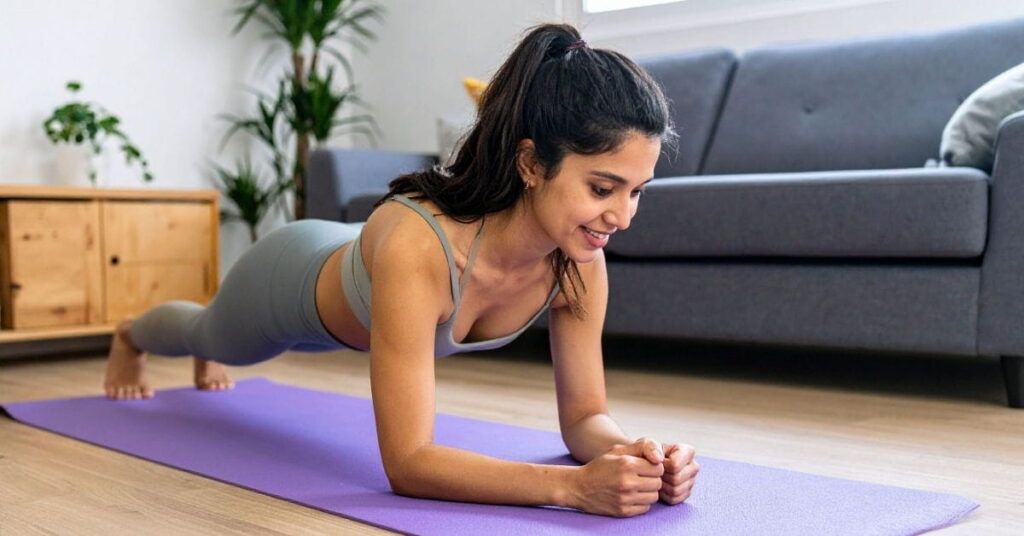
7. Plank
Planks are a core-focused exercise that strengthens the abs, back, shoulders, and glutes. This isometric movement builds endurance, improves posture, and stabilizes the spine.
Planks are ideal for beginners as they require no equipment and can be modified by lowering the knees for reduced intensity while still engaging the core.
How to Do It?
- Begin on the floor with forearms or hands directly under your shoulders, legs extended behind you, and toes tucked.
- Keep your body in a straight line from head to heels, engaging the core and glutes.
- Avoid sagging your hips or raising your rear; maintain alignment throughout the exercise.
- Keep your shoulders relaxed, drawing them away from your ears, and gaze slightly ahead of your hands.
- Breathe steadily and hold the position for a set duration, gradually increasing time as strength improves.
- If needed, modify by lowering knees while keeping a straight line from head to knees.
- Focus on tightening the core and maintaining tension in the back and glutes.
- Slowly release the plank after the set while keeping movements controlled.
How It Helps
Planks strengthen the core, shoulders, and back while improving posture, stability, and balance. They build endurance in multiple muscle groups and provide a solid foundation for other full-body exercises.
8. Dumbbell Bicep Curls
Dumbbell bicep curls focus on the front of the upper arms, specifically targeting the biceps. They help build arm strength, improve grip, and support functional movements like lifting and carrying objects. This exercise is accessible to beginners using light dumbbells, ensuring controlled and safe execution.
How to Do It?
- Stand with feet shoulder-width apart, holding a dumbbell in each hand with palms facing forward.
- Keep elbows tucked to your sides and maintain a straight back, engaging your core for balance.
- Slowly curl the dumbbells upward toward your shoulders by bending at the elbows, avoiding swinging your body.
- Pause briefly at the top to maximize contraction in the biceps.
- Lower the dumbbells in a controlled motion until arms are fully extended, keeping tension in the muscles.
- Breathe steadily, exhaling as you lift and inhaling as you lower the weights.
- Repeat for the desired number of repetitions, focusing on smooth, controlled movement.
- Adjust the weight if necessary to maintain proper form and prevent strain.
How It Helps
Dumbbell bicep curls strengthen the upper arms, improve grip strength, and enhance muscular endurance. They support daily lifting activities and contribute to balanced upper body development.
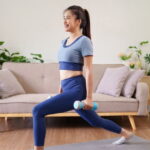
9. Lunges
Lunges are a lower-body exercise that targets the quadriceps, hamstrings, glutes, and calves. They improve balance, coordination, and unilateral leg strength, addressing muscular imbalances.
Lunges can be performed with body weight or dumbbells for added resistance, making them suitable for beginner full-body workouts at home.
How to Do It?
- Stand with feet hip-width apart, hands on hips or holding dumbbells at your sides.
- Step one foot forward and lower your body by bending both knees until the front thigh is parallel to the floor and the back knee nearly touches the ground.
- Keep your chest lifted, back straight, and core engaged throughout the movement.
- Ensure the front knee stays aligned over the ankle and does not extend past your toes.
- Push through the front heel to return to the starting position in a controlled manner.
- Alternate legs, repeating the movement on each side for the desired repetitions.
- Maintain steady breathing, inhaling as you lower and exhaling as you rise.
- Focus on smooth, controlled movements to improve balance and stability.
How It Helps
Lunges strengthen the lower body, improve balance, and promote unilateral muscle development. They enhance functional fitness, coordination, and hip mobility, supporting everyday movements and other exercises.
10. Superman Exercise
The Superman exercise targets the lower back, glutes, and shoulders, strengthening the posterior chain. This movement improves posture, spinal stability, and core engagement.
It is beginner-friendly, requires no equipment, and complements other full-body exercises by balancing front and back muscle development.
How to Do It?
- Lie face down on the floor with arms extended in front of you and legs straight.
- Engage your core and glutes while lifting your arms, chest, and legs off the ground simultaneously.
- Hold the raised position for a few seconds, focusing on controlled movement and muscle engagement.
- Avoid overextending your lower back, maintaining a gentle lift rather than straining.
- Slowly lower arms, chest, and legs back to the floor in a controlled motion.
- Breathe steadily, exhaling as you lift and inhaling as you lower.
- Repeat for the desired number of repetitions, keeping the movements smooth and deliberate.
- Focus on squeezing glutes and back muscles to maximize the effectiveness of the exercise.
How It Helps
The Superman exercise strengthens the lower back, glutes, and shoulders while improving posture and spinal stability. It enhances core support, reduces risk of lower back pain, and balances anterior and posterior muscle development.
11. Glute Bridge
The glute bridge is a lower-body exercise that targets the glutes, hamstrings, and core while activating the lower back. It improves hip mobility, strengthens the posterior chain, and supports better posture.
This beginner-friendly movement can be performed with body weight or with a dumbbell resting on the hips for added resistance.
How to Do It?
- Lie on your back with knees bent and feet flat on the floor, hip-width apart, and arms at your sides.
- Engage your core and squeeze your glutes as you lift your hips toward the ceiling, creating a straight line from shoulders to knees.
- Pause at the top for a few seconds, focusing on contraction in the glutes and hamstrings.
- Slowly lower your hips back to the starting position in a controlled manner, avoiding any sudden drops.
- Keep your feet firmly planted on the ground and avoid arching your lower back excessively.
- Breathe steadily, exhaling as you lift and inhaling as you lower.
- Repeat for the desired number of repetitions, ensuring smooth and deliberate movements.
- Optional: Place a dumbbell on your hips to increase resistance as strength improves.
How It Helps
Glute bridges strengthen the glutes, hamstrings, and core while improving hip mobility and spinal alignment. They support posture, reduce risk of lower back strain, and enhance overall lower-body stability for daily activities.
12. Mountain Climbers
Mountain climbers are a dynamic, full-body exercise that targets the core, shoulders, chest, and legs while boosting cardiovascular fitness.
This high-intensity movement helps improve endurance, coordination, and agility. Mountain climbers are perfect for beginners when performed at a controlled pace to build strength gradually.
How to Do It?
- Begin in a straight-arm plank position with hands under shoulders and body forming a straight line from head to heels.
- Engage your core, keeping your back flat, and bring one knee toward your chest while keeping the other leg extended.
- Quickly switch legs, alternating knees toward the chest in a running motion while maintaining proper form.
- Avoid lifting your hips too high or letting your lower back sag; maintain alignment throughout.
- Breathe steadily, exhaling as each knee comes forward and inhaling as you switch legs.
- Start at a comfortable pace and gradually increase speed as endurance improves.
- Focus on controlled movements rather than rushing, ensuring proper engagement of the core and upper body.
- Repeat for the desired time or number of repetitions, maintaining steady rhythm and posture.
How It Helps
Mountain climbers improve cardiovascular endurance, strengthen the core, shoulders, and legs, and enhance coordination. They also promote calorie burning and full-body engagement, supporting overall fitness and functional strength.
13. Dumbbell Deadlift
The dumbbell deadlift is a strength-building exercise that targets the hamstrings, glutes, lower back, and core. It helps improve posture, build posterior chain strength, and enhance functional movements like lifting objects safely. Beginners can use light dumbbells to focus on proper form and gradual progression.
How to Do It?
- Stand with feet hip-width apart, holding a dumbbell in each hand in front of your thighs with palms facing your body.
- Engage your core and keep a slight bend in the knees as you hinge forward at the hips, lowering the dumbbells toward the floor.
- Maintain a straight back, shoulders pulled back, and avoid rounding your spine during the movement.
- Lower the dumbbells until you feel a stretch in your hamstrings without straining your lower back.
- Press through your heels and squeeze your glutes as you return to the standing position.
- Breathe steadily, exhaling as you lift and inhaling as you lower the dumbbells.
- Repeat for the desired number of repetitions, focusing on smooth, controlled motion.
- Adjust weight as needed, prioritizing form over load to prevent injury.
How It Helps
Dumbbell deadlifts strengthen the hamstrings, glutes, lower back, and core, improving posture, stability, and overall functional strength. This exercise supports safe lifting techniques and builds a strong foundation for other full-body movements.
14. Side Plank
Side planks are a core-focused exercise that strengthens the obliques, shoulders, and hips. They improve lateral stability, balance, and spinal support. This exercise is beginner-friendly, with modifications such as lowering the bottom knee for added support while still targeting the obliques and core effectively.
How to Do It?
- Lie on your side with your legs extended, stacking your feet on top of each other, and place your elbow directly under your shoulder.
- Engage your core and lift your hips to form a straight line from head to heels.
- Keep your shoulders relaxed and chest open while maintaining balance.
- Hold the position for the desired duration, focusing on tension in the obliques and shoulders.
- Slowly lower your hips back to the floor in a controlled motion to complete one repetition.
- Breathe steadily, exhaling as you lift and inhaling as you lower.
- Repeat on the opposite side to ensure balanced strength development.
- Modify by bending the bottom knee for extra support if needed while maintaining alignment.
How It Helps
Side planks strengthen the obliques, shoulders, and hips, improve balance and lateral stability, and provide spinal support. They enhance core endurance and contribute to overall full-body strength and posture.
15. Dumbbell Chest Fly
The dumbbell chest fly is an upper-body exercise targeting the chest muscles while engaging the shoulders and arms. It builds strength, improves upper-body mobility, and enhances functional pushing movements. Beginners can perform this exercise on the floor or a bench using light dumbbells to ensure safe execution.
How to Do It?
- Lie on your back with knees bent and feet flat on the floor or on a bench, holding a dumbbell in each hand above your chest with palms facing each other.
- Keep a slight bend in your elbows throughout the movement to reduce shoulder strain.
- Slowly lower your arms out to the sides, creating a wide arc while maintaining the bend in your elbows.
- Lower until your arms are parallel to the floor or until you feel a gentle stretch in the chest.
- Press the dumbbells back up to the starting position, squeezing the chest muscles at the top.
- Breathe steadily, exhaling as you lift and inhaling as you lower the weights.
- Repeat for the desired number of repetitions, focusing on controlled motion and chest activation.
- Adjust weight as needed to maintain proper form and avoid overextension.
How It Helps
Dumbbell chest flies strengthen the chest, shoulders, and arms while improving upper-body mobility and posture. They enhance functional pushing movements and contribute to balanced upper-body development.
16. Dumbbell Shoulder Lateral Raise
The dumbbell shoulder lateral raise targets the side deltoids and upper traps, helping to build shoulder strength and shape. It also engages the core for stability while improving shoulder mobility. Beginners should start with light dumbbells to maintain control and avoid overloading the joints.
How to Do It?
- Stand with feet shoulder-width apart, holding a dumbbell in each hand at your sides with palms facing inward.
- Keep a slight bend in your elbows and engage your core for stability.
- Slowly lift both arms out to the sides until they reach shoulder height, keeping wrists in line with elbows.
- Pause for a second at the top to feel tension in the shoulder muscles.
- Lower the dumbbells slowly back to the starting position, maintaining controlled motion.
- Avoid swinging your arms or using momentum; focus on smooth, deliberate movement.
- Breathe steadily, exhaling as you lift and inhaling as you lower.
- Repeat for the desired number of repetitions, adjusting weight to ensure proper form.
How It Helps
Lateral raises strengthen the side deltoids and upper traps, improving shoulder stability, posture, and upper-body definition. They also engage the core, supporting overall balance and full-body coordination.
17. Dumbbell Hammer Curl
The dumbbell hammer curl strengthens the biceps and forearms while improving grip strength. This exercise is ideal for beginners because it maintains a neutral wrist position, reducing strain on the joints and promoting safe arm development.
How to Do It?
- Stand with feet shoulder-width apart, holding a dumbbell in each hand with palms facing your torso.
- Keep your elbows close to your body and core engaged throughout the exercise.
- Curl the dumbbells up toward your shoulders, maintaining palms facing inward and avoiding rotation.
- Pause briefly at the top, feeling the contraction in your biceps and forearms.
- Slowly lower the weights back down to the starting position with controlled motion.
- Breathe steadily, exhaling as you lift and inhaling as you lower.
- Avoid swinging your arms or using momentum to lift the dumbbells.
- Repeat for the desired repetitions, focusing on smooth, deliberate motion.
How It Helps
Hammer curls strengthen the biceps and forearms, improve grip strength, and support functional movements such as lifting and carrying. They contribute to balanced arm development and enhance overall upper-body strength.
18. Bodyweight Squat
Bodyweight squats are a foundational lower-body exercise targeting the quads, glutes, and hamstrings while engaging the core. This movement enhances mobility, stability, and functional leg strength, making it essential for beginners starting a full-body fitness routine.
How to Do It?
- Stand with feet shoulder-width apart, toes slightly turned out, and arms extended in front for balance.
- Engage your core and begin bending at the hips and knees, lowering your body as if sitting back into a chair.
- Keep your chest lifted and back straight, avoiding forward leaning or rounding of the spine.
- Lower until your thighs are parallel to the floor or as comfortable while maintaining proper form.
- Press through your heels to return to standing, squeezing your glutes at the top.
- Breathe steadily, exhaling as you rise and inhaling as you lower.
- Repeat for the desired number of repetitions, focusing on controlled motion.
- Optional: Add a dumbbell held at chest height for extra resistance once strength improves.
How It Helps
Bodyweight squats strengthen the lower body, improve balance, stability, and mobility, and engage the core. They support functional movements like sitting, standing, and walking while promoting overall fitness and endurance.
19. Dumbbell Russian Twist
The dumbbell Russian twist targets the obliques and core while improving rotational strength and stability. This exercise also engages the shoulders and arms when holding the dumbbell, providing a complete upper-body and core workout for beginners.
How to Do It?
- Sit on the floor with knees bent and feet flat or slightly lifted for added difficulty, holding a dumbbell with both hands in front of your chest.
- Lean back slightly, engaging your core to maintain balance and avoid rounding the spine.
- Rotate your torso to one side, moving the dumbbell across your body while keeping your arms slightly bent.
- Return to the center and rotate to the opposite side in a controlled motion.
- Breathe steadily, exhaling as you twist and inhaling as you return to center.
- Avoid jerking or swinging the dumbbell; maintain slow, controlled movements.
- Repeat for the desired number of repetitions, ensuring full rotation from side to side.
- Focus on engaging the obliques rather than relying solely on arm movement.
How It Helps
Dumbbell Russian twists strengthen the obliques, core, and upper body, improving rotational stability, balance, and posture. This exercise also enhances functional strength for everyday movements involving twisting or turning.
20. Plank with Shoulder Tap
The plank with shoulder tap is a core and upper-body exercise that strengthens the shoulders, arms, and abdominal muscles while improving balance and coordination. It is a beginner-friendly variation of the standard plank, incorporating dynamic movement.
How to Do It?
- Begin in a straight-arm plank position with hands directly under shoulders and feet hip-width apart.
- Engage your core, keeping your back flat and hips stable to prevent swaying.
- Lift one hand off the ground and tap the opposite shoulder while maintaining alignment.
- Return the hand to the floor and repeat on the opposite side, alternating shoulder taps.
- Breathe steadily, exhaling as you lift your hand and inhaling as you return.
- Avoid rotating your hips or shifting weight excessively during the movement.
- Maintain a slow, controlled pace to ensure core engagement throughout.
- Repeat for the desired number of repetitions, focusing on stability and proper form.
How It Helps
Plank with shoulder taps strengthens the core, shoulders, and arms, improving balance, stability, and coordination. It also enhances posture and functional strength for daily activities that require core engagement and upper-body control.
Conclusion
This beginner-friendly full-body workout at home provides a comprehensive approach to building strength, improving mobility, and boosting endurance without the need for complex equipment. By following these exercises consistently and maintaining proper form, beginners can safely achieve full-body fitness, develop healthy habits, and experience the physical and mental benefits of regular exercise. Remember, progress takes time, so stay consistent, listen to your body, and enjoy the journey to a stronger, healthier you.