
Have you ever wondered how a simple pair of dumbbells could transform your daily fitness routine without requiring hours in a gym? Dumbbells are one of the most versatile tools for strength, balance, and endurance, allowing you to target multiple muscle groups in a single session.
Whether you’re a beginner or someone who exercises regularly, incorporating dumbbell workouts into your schedule can lead to noticeable improvements in strength, posture, and energy levels.
With the right techniques, these exercises can be performed anywhere, from a living room to a small home gym, offering convenience and effectiveness that few other tools provide.
Benefits of Using Dumbbells for Everyday Workouts
Dumbbells offer an exceptional range of benefits that make them ideal for daily fitness routines. One of the most significant advantages is their ability to target specific muscle groups while also engaging stabilizing muscles.
Unlike machines, which often limit your movement to a fixed path, dumbbells allow for a natural range of motion, reducing the risk of joint strain and promoting functional strength. Using dumbbells regularly can improve muscle coordination, balance, and flexibility, as you are required to control each weight independently.
In addition, dumbbell workouts can be easily adapted for all fitness levels. Beginners can start with lighter weights and gradually progress, while advanced users can increase resistance or incorporate complex movements to challenge the body.
They are also excellent for compound exercises that work multiple muscle groups simultaneously, such as chest presses, rows, and lunges, allowing for more efficient calorie burning and strength building.
Moreover, dumbbells encourage unilateral training, which addresses muscle imbalances by forcing each side of the body to work equally. This not only improves symmetry but also reduces the likelihood of injuries caused by overcompensation.
The portability of dumbbells makes them a convenient option for home workouts or while traveling, eliminating dependence on gym equipment.
By consistently including dumbbells in your daily routine, you can achieve better overall muscle tone, endurance, and stability, leading to improved performance in both everyday activities and athletic pursuits.
Choosing the Right Dumbbell Weight
Selecting the appropriate dumbbell weight is essential to maximize results while avoiding injury. Here are key points to consider:
- Assess Your Fitness Level: Beginners should start with lighter weights to learn proper form and technique. A comfortable range is typically between 5 to 15 pounds for most exercises.
- Exercise Type Matters: Compound movements like squats or lunges may require heavier weights compared to isolation exercises like bicep curls.
- Test for Fatigue: The correct weight allows you to complete the last 2–3 repetitions with effort but without compromising form. If you can lift the weight effortlessly, it is too light; if you struggle to maintain proper form, it is too heavy.
- Incremental Progression: Gradually increasing weight in small increments ensures continuous strength gains and reduces the risk of injury.
- Consider Goals: For strength building, heavier weights with fewer repetitions are ideal, whereas lighter weights with higher repetitions support endurance and toning.
- Adjust for Repetitions: If an exercise feels easy midway through your set, slightly increasing the weight can maintain its effectiveness.
- Listen to Your Body: Pay attention to joint or muscle discomfort that signals the weight may be inappropriate. Proper selection enhances results and prevents setbacks.
Safety Tips Before Starting a Dumbbell Workout
- Warm-Up First: Always perform 5–10 minutes of dynamic stretches or light cardio to increase blood flow and reduce injury risk.
- Maintain Proper Form: Focus on controlled movements rather than heavy lifting. Poor form can lead to strains or long-term injuries.
- Start Light: Begin with manageable weights and increase gradually as strength improves.
- Use a Stable Surface: Ensure you are on a flat, non-slip surface to prevent falls during exercises.
- Engage Core Muscles: Activating your core provides stability, reduces lower back strain, and improves overall posture.
- Breathe Correctly: Inhale during lowering movements and exhale while lifting, maintaining a steady rhythm throughout.
- Avoid Overtraining: Give muscles time to recover between sessions to prevent fatigue, soreness, and injuries.
- Keep Equipment Safe: Inspect dumbbells for damage, and ensure the grip is secure to avoid accidental drops.
1. Dumbbell Goblet Squat
The Dumbbell Goblet Squat is a lower-body exercise that strengthens the quads, glutes, and hamstrings while also engaging the core. Holding a dumbbell close to your chest forces your upper body to remain upright, enhancing posture and balance.
This movement mimics natural sitting and standing motions, making it functional for daily activities and improving overall lower-body strength. It is suitable for all fitness levels and can be performed anywhere with minimal space.
How to Do It?
- Stand with feet shoulder-width apart, holding a dumbbell vertically against your chest with both hands.
- Keep your chest up and shoulders back as you initiate a squat by pushing your hips back and bending your knees.
- Lower your body until your thighs are parallel to the floor or slightly below, maintaining weight on your heels.
- Pause briefly at the bottom, ensuring knees don’t cave inward.
- Press through your heels to return to standing, keeping the dumbbell close to your chest.
- Repeat for desired repetitions, maintaining a steady and controlled motion throughout.
How It Helps:
The Goblet Squat primarily targets the quadriceps and glutes, enhancing lower-body strength and stability. Holding the weight close to your chest, it also engages core muscles, improving balance and posture.
This exercise promotes functional strength, which translates to better performance in daily tasks such as lifting, bending, and climbing stairs, while supporting joint health.
2. Dumbbell Bench Press
The Dumbbell Bench Press targets the chest, shoulders, and triceps, offering a more natural range of motion than a barbell. Using dumbbells individually ensures each arm works independently, addressing muscular imbalances.
It also stabilizes the shoulders and engages supporting muscles, making it effective for upper body strength and functional pushing movements. This exercise can be performed on a flat or incline bench for varied muscle activation.
How to Do It?
- Lie flat on a bench with a dumbbell in each hand, palms facing forward, and feet planted firmly on the ground.
- Press the dumbbells upward until arms are fully extended, keeping elbows slightly bent at the top to protect joints.
- Slowly lower the dumbbells toward your chest, ensuring controlled movement and maintaining shoulder stability.
- Pause briefly at the bottom before pressing upward again, focusing on chest contraction.
- Avoid arching your back excessively and keep the movement steady.
- Repeat for the desired number of repetitions, ensuring smooth breathing throughout the exercise.
How It Helps:
The Dumbbell Bench Press strengthens the pectoral muscles, shoulders, and triceps, improving upper body power for pushing movements.
It enhances shoulder stability and coordination, which supports better posture and reduces injury risk. Working each arm independently, it promotes muscular symmetry, ensuring balanced development and functional strength.
3. Dumbbell Romanian Deadlift
The Dumbbell Romanian Deadlift focuses on the hamstrings, glutes, and lower back, making it a powerful exercise for posterior chain strength. Unlike traditional deadlifts, the movement emphasizes hip hinge mechanics, teaching proper lifting technique and improving flexibility in the hamstrings.
It also engages the core to maintain balance and stability, reducing strain on the lower back. This exercise is ideal for both beginners and advanced lifters looking to build lower-body and posterior strength.
How to Do It?
- Stand with feet hip-width apart, holding a dumbbell in each hand in front of your thighs with palms facing the body.
- Slightly bend your knees while keeping your back straight and your shoulders pulled back.
- Hinge at the hips, pushing them backward as you lower the dumbbells toward the mid-shin, maintaining a neutral spine.
- Keep your chest lifted and core engaged throughout the movement.
- Slowly return to the standing position by driving your hips forward and squeezing the glutes at the top.
- Repeat for the desired number of repetitions, moving in a controlled and deliberate manner.
How It Helps:
Strengthens hamstrings, glutes, and lower back muscles while improving hip mobility and posture. Engaging the core enhances stability and reduces the risk of injury. It teaches proper lifting mechanics, which translates to safer performance in daily activities like bending, lifting, and carrying objects.
4. Dumbbell Shoulder Press
Targets the deltoids, triceps, and upper chest, enhancing upper body strength and shoulder stability. Using dumbbells instead of a barbell allows for a more natural range of motion, reducing shoulder stress.
It also engages core muscles to maintain balance, making it a functional exercise that improves overhead strength and posture.
How to Do It?
- Stand or sit with feet shoulder-width apart, holding a dumbbell in each hand at shoulder height, palms facing forward.
- Engage your core and press the dumbbells upward until your arms are fully extended overhead, keeping elbows slightly bent.
- Slowly lower the dumbbells back to shoulder height with control, avoiding rapid movements.
- Ensure the shoulders remain stable, and avoid arching your back excessively during the lift.
- Maintain steady breathing, exhaling as you press upward and inhaling while lowering.
- Repeat for the desired repetitions, keeping movements deliberate and precise.
How It Helps:
Strengthens deltoids, triceps, and upper chest, improving upper body power and mobility. Enhances posture, balance, and overhead strength while reducing shoulder injury risk.
5. Dumbbell Bent-Over Row
Primarily targets the back muscles, including the lats, rhomboids, and traps, while also engaging biceps and core. Excellent for improving posture, pulling strength, and upper body stability.
How to Do It?
- Hold a dumbbell in each hand with palms facing your body, and stand with feet hip-width apart.
- Hinge at the hips, keeping your back straight and chest slightly lifted, letting the dumbbells hang toward the floor.
- Pull the dumbbells toward your torso by bending your elbows and squeezing your shoulder blades together at the top.
- Pause briefly, then slowly lower the weights back to the starting position with control.
- Maintain a neutral spine, avoid rounding the back, and keep the core engaged throughout.
- Repeat for the desired number of repetitions, ensuring smooth, controlled movements.
How It Helps:
Strengthens the upper and mid-back, improves posture and shoulder stability, and engages biceps and core for overall upper body coordination. Supports functional pulling movements.
6. Dumbbell Lateral Raise
Isolates the lateral deltoid muscles, building shoulder width and improving arm strength. Engages stabilizing muscles in the upper back and core for better posture and shoulder alignment.
How to Do It?
- Stand with feet shoulder-width apart, holding a dumbbell in each hand at your sides with palms facing inward.
- Keep a slight bend in the elbows and engage your core.
- Raise the dumbbells out to the sides until they reach shoulder height, maintaining a controlled motion.
- Avoid shrugging your shoulders and keep movements smooth without jerking the weights.
- Slowly lower the dumbbells back to the starting position, focusing on muscle control.
- Repeat for the desired number of repetitions, maintaining steady breathing and posture.
How It Helps:
Strengthens side deltoids, improves shoulder definition and stability, engages upper back and core, and enhances functional shoulder movements.
7. Dumbbell Bicep Curl
Isolates the biceps, helping to build arm strength and definition while also engaging forearm muscles for grip stability. Supports functional movements like lifting, carrying, or pulling objects.
How to Do It?
- Stand with feet shoulder-width apart, holding a dumbbell in each hand with palms facing forward.
- Keep elbows close to your torso and shoulders relaxed.
- Curl the dumbbells upward toward your shoulders by bending the elbows, keeping upper arms stationary.
- Pause briefly at the top, focusing on contracting the biceps fully.
- Slowly lower the dumbbells back to the starting position with control.
- Repeat for the desired number of repetitions, keeping movements deliberate and controlled.
How It Helps:
Strengthens biceps and forearms, improving pulling strength and functional arm use. Enhances muscle tone, endurance, and joint stability.
8. Dumbbell Tricep Kickback
Isolates the triceps, essential for pushing movements and upper arm stability. Engages shoulders and core for balance.
How to Do It?
- Hold a dumbbell in each hand with palms facing your body and hinge forward at the hips, keeping your back straight.
- Bend your elbows at a 90-degree angle so the upper arms are parallel to your torso.
- Extend your forearms backward until the arms are fully straight, squeezing the triceps at the top.
- Slowly return to the starting position, controlling the weights without swinging.
- Keep your core engaged to maintain stability.
- Repeat for the desired repetitions, moving in a slow and deliberate manner.
How It Helps:
Strengthens triceps, improves pushing strength and arm stability, enhances upper body muscle balance, and supports functional arm extension movements
9. Dumbbell Step-Up
The Dumbbell Step-Up is a lower-body exercise that strengthens the glutes, quads, and hamstrings while engaging the core for balance. Performing this movement with dumbbells adds resistance, improving functional fitness. It mimics everyday movements such as climbing stairs, enhancing coordination, and unilateral leg strength.
How to Do It?
- Hold a dumbbell in each hand at your sides and stand in front of a sturdy bench or step.
- Step onto the bench with one foot, pressing through the heel to lift your body upward.
- Bring the other leg up to stand fully on the bench while keeping the core engaged.
- Step back down carefully, leading with the same leg, maintaining controlled movement.
- Alternate legs with each repetition, ensuring stability and balance throughout.
- Keep your chest up and avoid leaning forward.
How It Helps:
Strengthens glutes, quads, and hamstrings while improving balance, coordination, and unilateral leg strength. Mimics functional daily movements, enhances core engagement, and reduces risk of falls.
10. Dumbbell Chest Fly
Targets the pectoral muscles, emphasizing stretching and contracting through a wide range of motion. Engages shoulders and stabilizing muscles for better posture and functional pushing strength.
How to Do It?
- Lie flat on a bench with a dumbbell in each hand, palms facing each other and arms extended above your chest.
- With a slight bend in the elbows, lower the dumbbells outward in a wide arc until your arms are level with your chest.
- Pause briefly, feeling the stretch in your chest muscles.
- Bring the dumbbells back together over your chest, maintaining control.
- Engage your core and keep your feet firmly on the ground.
- Repeat for the desired repetitions with steady breathing.
How It Helps:
Strengthens pectorals while improving shoulder stability and range of motion. Enhances functional pushing strength, promotes balanced upper body development, and supports better posture.
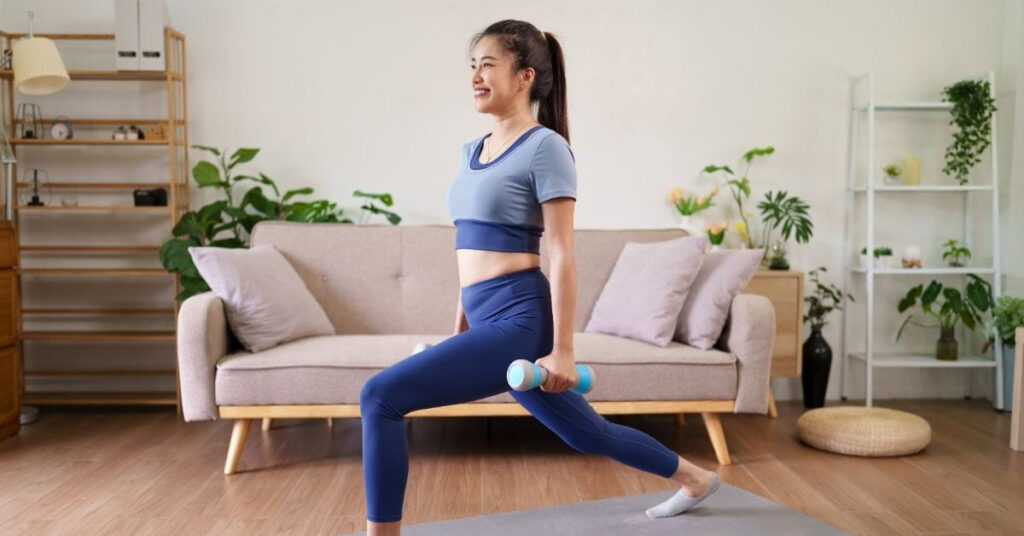
11. Dumbbell Reverse Lunge
Targets quads, hamstrings, and glutes while improving balance and coordination. Adding dumbbells increases resistance, enhancing lower-body strength and stability.
How to Do It?
- Hold a dumbbell in each hand at your sides and stand tall with feet hip-width apart.
- Step one leg backward into a lunge, lowering the back knee toward the floor while keeping the front knee aligned with the ankle.
- Keep your torso upright and core engaged for stability.
- Push through the front heel to return to the starting position.
- Alternate legs for each repetition, maintaining controlled movements.
- Repeat for the desired number of repetitions, focusing on smooth motion.
How It Helps:
Strengthens the lower body, improves balance, coordination, and unilateral leg strength. Engages the core for stability and reduces the risk of falls or muscular imbalances.
12. Dumbbell Front Raise
Isolates the anterior deltoids, building shoulder strength and definition. Engages upper chest and stabilizing muscles for better posture and functional lifting movements.
How to Do It?
- Stand with feet shoulder-width apart, holding a dumbbell in each hand at your sides with palms facing backward.
- Engage your core and slowly lift the dumbbells straight in front of you until they reach shoulder height, keeping elbows slightly bent.
- Pause briefly at the top, then slowly lower the weights back to the starting position.
- Maintain a controlled pace without swinging the arms, keeping shoulders relaxed.
- Repeat for the desired number of repetitions, focusing on smooth and deliberate movement.
How It Helps:
Strengthens front deltoids, upper chest, and stabilizing muscles. Improves shoulder mobility, functional overhead strength, and posture while reducing injury risk.
13. Dumbbell Russian Twist
Engages obliques, core, and lower back, improving rotational strength and stability. Adding a dumbbell increases resistance, enhancing functional core training.
How to Do It?
- Sit on the floor with knees bent, heels slightly raised, holding a dumbbell with both hands at chest level.
- Lean back slightly, engaging the core for stability.
- Rotate your torso to one side, bringing the dumbbell beside your hip.
- Rotate to the other side in a controlled manner, keeping your back straight.
- Avoid rounding your shoulders and maintain steady breathing.
- Repeat for the desired number of repetitions, focusing on slow, deliberate movements.
How It Helps:
Strengthens obliques, core, and lower back, enhancing rotational stability and balance. Supports functional twisting movements and overall core integrity, reducing risk of injury.
14. Dumbbell Calf Raise
Targets calf muscles, improving lower leg strength, stability, and endurance. Holding dumbbells adds resistance for enhanced muscle development.
How to Do It?
- Stand with feet hip-width apart, holding a dumbbell in each hand at your sides.
- Engage your core and slowly lift your heels off the floor, balancing on the balls of your feet.
- Pause at the top, feeling the contraction in the calves.
- Slowly lower your heels back to the ground with control.
- Maintain upright posture and avoid leaning forward or backward.
- Repeat for the desired number of repetitions.
How It Helps:
Strengthens calves, improves ankle stability, balance, and lower body endurance. Supports functional movements like walking, running, and climbing stairs.
15. Dumbbell Shrugs
Strengthens trapezius muscles in the upper back and shoulders, improving posture and neck stability. Simple yet effective for upper body strength.
How to Do It?
- Stand with feet shoulder-width apart, holding a dumbbell in each hand at your sides with palms facing inward.
- Keep your arms straight and engage your core.
- Shrug your shoulders upward toward your ears as high as possible without bending your elbows.
- Pause at the top, then slowly lower the shoulders back to the starting position.
- Repeat for the desired number of repetitions, keeping controlled motion and proper posture.
How It Helps:
Targets traps, enhancing upper back strength, neck stability, and posture. Reduces tension in shoulders and neck, supporting functional movements and daily activities.
Conclusion
Incorporating dumbbell workouts into your everyday routine offers a simple, effective way to build strength, improve balance, and maintain overall fitness. By choosing the right weights, maintaining proper form, and combining exercises with a structured cool-down, you can achieve consistent results and support long-term health and functional strength.
Common Dumbbell Workout Mistakes to Avoid
Many people make avoidable mistakes during dumbbell workouts, which can hinder progress or lead to injuries. Common errors include:
- Using weights that are too heavy, compromising form.
- Neglecting proper warm-ups can lead to muscle strains or sprains.
- Swinging or jerking dumbbells instead of controlled movements.
- Ignoring balanced training, focusing only on certain muscle groups.
- Not engaging the core during standing exercises.
- Rushing through repetitions without mindful breathing.
- Skipping rest days or performing the same exercises daily without variation.
Paying attention to proper form, controlled movements, gradual weight progression, and balanced training ensures safer and more effective dumbbell workouts.
How Often to Do Dumbbell Workouts
The frequency depends on goals, fitness levels, and recovery:
- General Fitness: 3–4 times per week with rest days in between.
- Beginners: Start with two sessions per week and gradually increase.
- Strength or Hypertrophy: Target each major muscle group 2–3 times weekly through full-body sessions or split routines.
- Variety: Change exercises, sets, or repetitions periodically to prevent plateaus.
- Listen to Your Body: Soreness is normal; persistent pain signals the need for rest or intensity adjustment.
Consistency, proper form, and balanced progression are more important than daily heavy workouts, ensuring long-term improvements in strength, endurance, and overall fitness.
Stretching and Cool-Down After Dumbbell Training
Cooling down after a dumbbell workout helps muscles recover, prevents stiffness, and reduces soreness. Stretching improves flexibility, circulation, and aids lactic acid removal.
- Start with light cardio for 3–5 minutes.
- Follow with dynamic stretches for all major muscle groups.
- Hold each stretch 20–30 seconds, maintaining deep, steady breathing.
- Focus on chest, shoulders, back, biceps, triceps, quads, hamstrings, glutes, and calves.
- Avoid bouncing; perform controlled, gentle movements.
A proper cool-down promotes faster recovery, reduces muscle tension, and prepares your body for future workouts.